Thursday, October 1, 2015

Guglielmo la Gazzella

Let’s ride Coast to Coast; from the Adriatic to the Mediterranean.  We did just that and thanks to friends Gil Rappaport and Mike Perlmutter, I was invited on the trip, organized by Ciclismo, a high-end Italian bike touring company.


Eight days of riding,  about 400 miles or so and 24000 ft of climbing, give or take. We made it up a "virtual" Annapurna, even if we missed climbing Everest and along the way, I must have consumed three dozen macchiatos and even more glasses of fine Italian wine. Here we start from Pesaro on one of the rare wet days. 


The senior guide did warn us that the trip would be quite intense (his word).  He was right: in addition to the days' rides there were history lessons, Italian lessons, wine tasting and various tours. We are pretty much on the go from about 6 in the morning till 11 at night and by the end of the trip, we understood what he meant. What a hardship!


We had hills-a-plenty but they were usually longish rather than steep.


All the towns we traveled through were "drop-dead" gorgeous with narrow winding streets that must have held many secrets. All our hotels were centrally-located and several were been built in the 13th or 14th centuries. I suppose I can forgive the fact that the décor and furnishings of a few were inevitably rather tired looking.


Over many parts of Central Italy, massive volcanic activity spewed hundreds of feet of ash (tuff), some of which resisted erosion and formed the foundations of many of the medieval hill towns.


Each town square has its Duomo and Town Hall.  Most are huge and impressive though often rather inelegant.


And I was constantly being warned what might happen if I do not mend my ways.


On the occasion below, a well-known wine merchant hires a Michelin-star chef to cook for us. Sadly (for him), though the food and wine were delicious, no sales transactions were consummated. I guess most cyclists are just not into $80 bottles of wine.


Here I was trying to blend in with the local bathers at the Saturni thermal springs. More white quivering flesh than you can shake a stick at.


Occasionally, we did allow our achievements to get the better of us ......


But then, we did make it, finishing up at Porto Ercole, yeah ...... !!!!


Wednesday, September 30, 2015

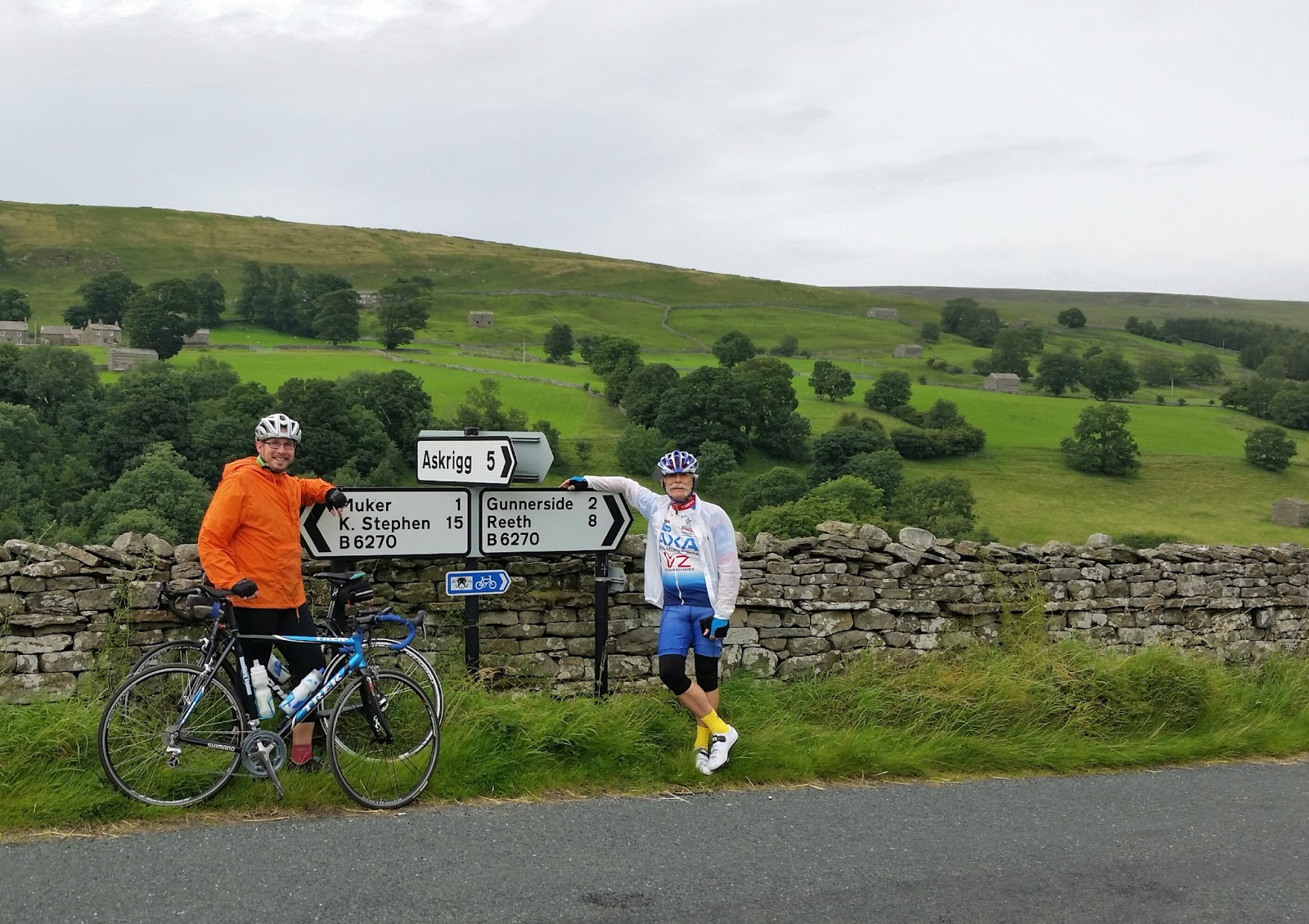
A Yorkshire cycling interlude

The Yorkshire Dales are a series of predominantly east-west rivers in Northern England separated by high fells of dramatic limestone crags and moorland often covered in purple heather.


 The lower levels of the Dales are divided up into arable fields by dry-stone walls, some of which date back to Anglo-Saxon times. 


Gushing springs spew torrents of clear water from the karst limestone. These form becks (streams) that are quickly turned golden brown as they flow through the peat on their way to the rivers below.


Old, old villages, in some instances dating back a thousand years or more, remain clustered on the rivers.


It was the stark beauty of the Dales, and the steep climbs that separate them, that attracted the Tour de France to the area for Le Grand Depart in 2014.


 Some remnants of Yorkshire’s enthusiasm for the tour remain.


A year later, I fulfilled one of my “bucket list” goals and spent a couple of weeks in the northern Dales (primarily Wensleydale, Wharfedale and Swaledale) revisiting Stage One of the tour …. on a bike, of course. Sharon and I rented a house in Middleham, where the Castle, built in 1170, had been the childhood home of Richard III.  


This then, was the base from which my nephew Nick and I set off on our two-wheeled adventures.  


 Of course, cycling up and down the valleys is not too difficult but to cross from one valley to another involved climbs that are not unusually 25% and, on the corners, can be even steeper.  In some instances, these gradients are configured in spectacular hair-pin bends; super-challenging to climb and scary to descend. 


I had rented a bike from a shop near Richmond. It was a reasonable quality carbon Bianchi but alas, equipped with woefully unsuitable gearing. Ideally one would have a 34/32 as the low gear for this terrain but my machine had only a 36/25.  One of my more embarrassing moments of the trip was on one notorious hill when I simply could not turn the pedals. It was a case of get off or fall off. 


 The other awkward incident was on a descent in wet weather when the brakes simply could not bring the bike down to a safe speed. That resulted in an unfortunate encounter with a bridge at the bottom where the turn was just too sharp. The medieval structure won but thankfully only bruised knuckles resulted.


Rural Yorkshire is a very bicycle-friendly part of the world.   Even in years long past, establishments welcomed cyclists as witnessed by this old CTC sign.


Of course, morning coffee with delicious “elevenses” is an essential part of a bike ride and many cafes go the extra mile for customers who arrive on two wheels. For example, Zarina's cafe in Kettlewell has a 10% discount for cyclists, good inventory of maps, several bike racks, floor pump etc. etc.  Most importantly, try their delicious scones with clotted cream and strawberry jam. Five star.


Yorkshire is having to replace a livestock-based economy with tourism though a few remnants of the traditional way of life remain.  This grim manifestation of English rural life was a surprise:  the results of the local mole catcher's efforts. The use of traps had died out with the introduction of poison. However when strychnine was outlawed in 2006, the traditional method of mole-slaughter returned.


 Of course, recreation in the evenings usually centered around one of England's greatest institutions.


Friday, August 7, 2015

HLM: Helmet, Lights, Mirror.

There are many ways a cyclist can improve his or her safety out on those shark-infested roads.  In recent years, one of my mantras has become:  HLM: Helmet, Lights, Mirror.

The research and literature about bicycle helmets is extensive, confusing and often misleading. In my opinion, the argument for the use of bicycle helmets by everybody and at all times is wholly compelling.  End of story. Back in the mid-80s I wrote an article for the CCC newsletter entitled “Heads You Win – if you still have one” so I was preaching helmet-lore way back then. More objectively, a controlled study of the effectiveness of bicycle helmets published in the New England Journal of Medicine concluded that: bicycle safety helmets are highly effective in preventing head injury and are equally important for adults and children. This is one of many pro-helmet articles in the medical literature. Google all the oceans of data if you will but rest assured, they do work.  All the ballyhoo about helmets promoting recklessness or decreasing the number of cyclists out on the roads is just that .…. smoke and mirrors. Nearly all helmets on the market in the US pass the minimum legal safety criteria so in my case I usually shop on price and color .…. it has to be blue.


 I was a late convert to the use of day-time lights, especially a bright strobe on the front.  I am truly astonished as to how visible a cyclist is who has  good lights.  The bike and the rider can be almost invisible in the shadows but the light keeps blinking away with a range of ¼ mile or more.  Motorists can no longer say “Oh I am sorry, I did not see you”.  The advances in lighting technology are remarkable. Rechargeable, highly-efficient lights are now fairly inexpensive to buy and run.  No excuses. I use a Cigolite Metro 400/Hotshot 2W combo set for about $70 http://www.cygolite.com/products/index.html but you can get perfectly good ones for much less.  You can also buy extra mounting brackets if you want to use them on more than one bike.


Mirrors are also invaluable. Not only can you see rear-approaching traffic but you can also keep track of your riding buddies (if you are ahead!).  The argument against mirrors is that a rider might be less inclined to communicate with drivers by looking backwards before making a maneuver so it is important to keep this in mind and always signal your intent. Mirrors are usually mounted on the helmet, glasses or handlebars. The one I use is the Safe Zone http://www.efficientvelo.com/safezone/  Advantages: Built like a tank and should last forever, easily adjustable, large mirror surface. Disadvantages: looks like a tank, twice the cost of many others.


Monday, July 27, 2015

The Tale of a Mountaineering Englishman in Texas


The story starts in 1924 when George Mallory and Andrew Irvine disappeared on the North-East ridge of Everest during their attempt to make the first ascent of the world's highest mountain. They were last seen when they were about 800 feet below the 29,029 ft summit (8,848 meters).  Now fast-forward to the early ‘90s when Mallory’s grandson, George (Junior) was training for a climbing expedition to Everest’s North Ridge. He came up with the idea of riding his bicycle up and down the 1,084m Mount Donna Buang in Australia, until he climbed Everest’s total elevation in one ride. In 1995, and after several attempts, he attained the magic 8,848 meters of cumulative climbing.

After Mallory’s successful “Everesting” climb, nothing much happened till about 2006 when others started to attempt the same feat.  Andy van Bergen of the "Hells 500" group in Australia then started to record the various efforts and these were subsequently documented on the Strava website. A few years later, Andy Coulbeck, a 51 year-old Englishman living in Austin started to explore Hells 500’s Everesting website http://www.everesting.cc/ and became hooked. Most successful attempts had been in Britain, Australia and New Zealand with a sprinkling in North America.  Would it not be the coolest thing to become the first successful Everester in Texas? And thus Andy’s idea became an obsession.


The rules are simple: the attempt must be on one hill and it must be in one single ride. You can stop but you cannot sleep.  Selection of the hill or mountain is of paramount importance and clearly what might work for one rider might not work for another. Most riders select grades of 4 – 9% and complete anything from 20 – 150 repeats over cumulative distances of 100 – 250 miles, taking 12 – 30 hours. That’s quite a range of permutations.

Andy’s first attempt was on Rain Creek Parkway in Austin. However, he had not determined the climb’s exact elevation and hence how many repeats would be needed.  After 22,000 ft. of climbing, he abandoned the attempt. Clearly more planning was going to be needed. After evaluating several climbs, he selected Big View Drive for his second attempt, also in northwest Austin. It was steep enough but offered some variety of climb with a leveling-off in the middle. He was to make the attempt in July.  He obviously had doubts about the high Texas summer temperatures but Andy was ready and he was impatient. Being first in Texas was now a primary motivator and who knows who else was out there thinking about it. Noel Coward did not get a vote ***.


So on the evening of Saturday 11th July, Andy set off to ride 70 hill repeats over a 2-mile (two-way) course. He started alone but during the grueling hours ahead he was supported by his wife Misako and a number of cycling friends, most notably David Ely who went “above and beyond”.  The night started in relative peace and tranquility but any thoughts of serenity were soon quashed by bouts of loneliness in the small hours of Sunday morning as the grim reality of what lay ahead became apparent.  He had planned to eat a burger during the night and by midnight, he was craving it.  Misako’s mission was thus to find a burger-joint that would still be open.  P. Terry’s provided the answer.


Andy originally planned for 16 minute repeats but as the sweltering Sunday dragged on, his breaks became longer and more frequent.  Any excuse to stop was a good excuse. His repeat times dropped, now 20 minutes, then 24 minutes. Occasional cramping set in but fortunately was alleviated with additional intake of electrolytes. By Sunday afternoon, Andy was exhausted and miserable in the 94 degree heat but quitting was not an option. Not only was his own resolve impenetrable but the support of his wife and friends had resulted in a firm commitment to them. And so at 7:20 in the evening, almost 26 hours after he started, Andy Coulbeck became the first cyclist in Texas to accomplish the Everesting goal of 29,029 ft of hill repeats. He also completed the ride in ambient temperatures higher than anybody else in the world.


When I asked Andy whether he was suffering from a mid-life crisis, he simply gave a wry smile, accompanied by giggles from Misako.  But when I asked him about other crazy adventures that he might attempt, his eyes seemed to glaze over and he stared off into the distance. Misako simply put her head in her hands.


William Hudson, July 2015.

***   "Mad Dogs and Englishmen" is a song written by Noël Coward and first performed in New York in 1931.  The locals grieve when the white men leave their huts, because they're obviously, definitely nuts …… though Mad Dogs and Englishmen go out in the midday sun.

Thanks to Misako Coulbeck and Jim Donahue for permission to use their photos.  Photo of Everest courtesy of Wikipedia. Photo of Strava record courtesy of Strava and Hells 500.


Sunday, May 27, 2012

Minivan bike rack


A friend asked about our minivan bike rack so I thought the easiest way to describe it was on my cycling blog.  The basic “model” would be for two bicycles with a couple of options, depicted at the end of this post. It could also be easily adapted for a pick-up truck. Thanks to my friend David for suggesting improvements to my original design.

Step One.  Buy a plank of wood 11 inches x ¾ inches x approx. 4 ft. The length should be about ¼ inch less than the width of the minivan at the point where the rack will sit. Do not use a width of less than 11 inches; otherwise the rack will slide around in the van. If you are rather obsessive, you can put a couple of coats of polyurethane on the plank.
Step Two. Buy at least two bike mounts. The ones I use are the XPORT universal bike mount, normally about $25 tho’ usually on sale at Performance for $19 and occasionally for even less.  Another options might be the Hollywood T970 Fork Mount or the Delta Bike Pro 2 Fork Mount.  Also buy four, one-inch inch stainless steel bolts with nuts and washers.


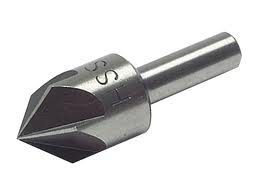
Step Three.  Position the two bike mounts in the centre of the plank and about 9 inches from the ends. Drill appropriate bolt holes and countersink the holes on the underneath of the plank which can then sit flat on the van floor. The countersink uses the type of bit shown below and needs to be enough to house the nuts. The washers are placed between the bolt head and the mount. Make sure everything is ultra-tight.


Step Four. Put adhesive-backed felt protector strips on the ends of the plank to prevent scuffing of the inside of the van.


Step Five. Mount the bikes (with front wheels removed) on the rack as shown with the bars facing the rear. The front wheels can be suspended from the hooks in the van with a mini-bungee or similar. It’s possible that you will also need a couple of bungees from the pedals to the minivan roof hooks to provide maximum stability.


Option One. As you can see in the photos, I actually have a third bike mount in the center of the plank because if I am on a long trip with only one bike, mounting it in the middle makes for much easier packing of all the other luggage.
Option Two. If you want to carry three bikes and three riders, you will most likely need to remove one of the center-row seats. Make another shorter (perhaps 3 ft.) version of the rack which then sits behind the front seats. Then mount the two outside bikes as normal with the third bike between them and reversed (back wheel at the rear of the van).

Sunday, February 27, 2011

Kids in a candy shop

Well it happened!  The North American Handmade Bicycle Show finally came to Austin. Talk about kids in a candy shop.   To see my Picasa album of some rather cool stuff there, go directly to:


https://picasaweb.google.com/WilliamPedalsOn/NAHBS?authkey=Gv1sRgCMyLkP_y9-6_GQ#  


Then go either to "Full Screen" or "Slide Show". 


Wednesday, February 9, 2011

Another Boneshaker

It’s happened again. Another rather innocuous-looking medal that commanded a fairly high price.

“LE VELOCIPEDE. La fantaisie le présente - L'industrie le patronne - La mode le reçoit - Le progrès l'encourage - Les arts utiles l'accueillent.

Perhaps an advertising promotion? Probably from the 1870s? Final eBay bid price was $412.

Wednesday, February 2, 2011

A medal so near & yet so far


As a collector of Art Nouveau & Art Deco cycling medals, I was intrigued by this lovely 1873 specimen on eBay. Although earlier than “my period”, its historical significance certainly caught my attention.

Consider that the late 19th century “bicycle” designs fall broadly into three periods, typified by these developments:

· 1864 – 1866. Development and marketing of the front-wheel drive velocipede (aka “boneshaker”) by Michaux/Lallement. In use till circa 1872 (example: demise of the Phantom “boneshaker” company).

· 1870. James Starley’s large front wheel drive high-wheeler (aka “penny farthing”). In use by the general public till circa 1890.

· 1885. John Kemp Starley’s chain/rear-sprocket drive “Rover” (aka “safety” bicycle). Essentially in use thereafter.

Dated medals from the high-wheeler era are not particularly rare but I have never seen a velocipede example quite as early as this. I was apparently not alone and sadly, it proved to be out of my league, commanding a final bid price of $774.

Thursday, January 27, 2011

1977 René Herse. US $11,211

Perhaps I no longer feel so bad if some aficionados are paying up to circa $10,000 for a contemporary bike. This beauty sold on eBay recently for $11,211, described as a “Top of the range” René Herse from 1977. Apparently made after Herse's death by Lily and Desbois.

Thursday, December 2, 2010

Pedal, dammit!

Note: Click on any photo to see larger version in Picasa.

Number 2482 leapt off the bridge into the bone-chilling, sixty-degree Arizona water along with 2400 other competitors. No turning back now; this was it.

She was about to find out how successful the last five months of intense Ironman training had really been.

She had faith in her training plan and felt pretty relaxed about the whole thing but could she really swim for 2.4 miles, then immediately ride for another 112 miles and finally complete the 26.2 mile marathon? How long will it take? How much Gu could her stomach handle? How she had come to loath that stuff.

Once in the water, there was no chance to daydream or to sing, she had to make sure that she did not get clobbered on the head by any of the others. Nevertheless, she was a good swimmer and got out of the water after only 1 hour 8 minutes followed by a smooth transition onto the bike.

The rain and the wind were tough with 25 mph gusts; this was to be the hardest thing to deal with. But now at least she could sing and sing she did throughout the next six hours as she maintained her 18-mph pace (primarily Ain’t No Mountain High Enough and Blame it on the Rain). She must conserve energy and take in extra nutrition on the bike so that she had plenty left for the final stage. One more transition and then onto the run. More singing.

She had been cautiously circumspect when asked what her target time for the whole event was. The allowable cutoff time was 17 hours, any first-timer that breaks fifteen hours is doing extremely well and thirteen hours would be considered truly outstanding. But maybe, just maybe she would do even better than that. Once well into the run, she realized that breaking twelve hours might be possible. Dare she hope? As the calls went back and forth between “Mission Control” in Austin and the onsite Arizona support team, it became increasingly clear that this indeed might be achievable.

Into the final stretch. A mile-long tunnel of spectators all cheering and shouting as she crossed over the finish line.

She is an Ironman! 11 hours, 50 minutes and 35 seconds. 15th in her Division. Our Tammy had done so well, so very well.

Note: Primary bike training partners in Austin were Red, David, Steven and Jerry. Mission Control in Austin consisted of David & Emily. Onsite support team were Dina & Shawn. Tammy’s Tri team is Austin T3, Inc.