
Thursday, October 7, 2010
He's baaaaaaaaaaaaack !!!!!!
Today was Stanton's inaugural ride as a "New Man". Fifteen of us helped him celebrate his return on the bike. Eight weeks after a massive cardiac arrest, 25 minutes or so on the "other side" and finally a successful quadruple bypass. His experiences were enlightening to us all from a temporal perspective. However, from a spiritual point of view, his ordeal was of no use to us. No insight as to what awaits us when our number is up. So I guess I will keep riding my bike on Sundays. Click on the photo for a full screen view.

Sunday, September 26, 2010
Beating up on a Mannequin
Beating up on a mannequin and then on a plastic doll did not seem to be a gentlemanly sport. But they could not protest and so the pummeling continued. And that is what it takes. When somebody’s heart has stopped, perhaps far from medical resources, CPR is the most effective way to keep oxygen flowing to the brain. And a defibrillator can sometimes restart the errant heart so that hopefully the outcome is not a tragedy.
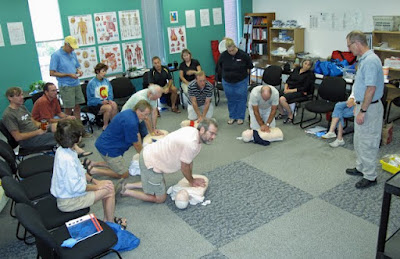
Inspired by Stan Truxillo’s remarkable recovery from a massive heart attack, in large measure the result of quickly-administered CPR, fifteen ACA members took the First Aid/CPR class offered by the Austin-Travis County EMS folks.

In addition to the CPR training itself, we learned how to recognize and respond to strokes, choking fits, seizures, heat-stroke, bleeding, broken limbs, snake bites, bee stings and a host of other potential disasters that we might encounter while out on the bikes.

The class was well-run, effective and fun for most of the time! Take it: you might save a life.

Note: the rest of the pictures are at
http://picasaweb.google.com/WilliamPedalsOn/CPRClasses?authkey=Gv1sRgCJjngtjF0v7R5AE#
Friday, August 27, 2010
The Ultimate Bicycle?
Robert Penn’s recent book, “It’s All About the Bike” is an account of the search for his dream bike http://www.telegraph.co.uk/culture/7906972/Its-All-About-the-Bike-by-Robert-Penn-review.html
It is a delightful blend of eulogies to contemporary component manufacturers, Penn’s own cycling reminisces and the historical background that explains why things are the way they are in the bicycle world. It’s the book that every self-respecting cyclist wishes they had written themselves. Getting paid for buying a custom bike ….. come on.
Inevitably there are some historical errors in the book (for example, aluminum frames originated in the late 19th century, not in the 1930s) and oodles of subjectivity but it is the latter that makes the book so entertaining. Any true bike nerd knows which component is “best” and any half dozen nerds in the same room will have as many opinions.
Penn chooses steel for the frame. I have had bikes in all four major materials and for sure, none is “best”. My current road bikes are titanium (the Spectrum by Tom Kellogg) and carbon (the Crumpton by Nick Crumpton). Thus my next custom frame (sorry Sharon) will logically be steel. However, Penn chooses Reynolds 953 ….. stainless !!! http://reynoldstechnology.biz/our_materials_953.php And it can be polished. Curiously, he opts for TIG welding rather than a lugged frame. Why would you give up the opportunity to have such artistry?
He chooses Brian Rourke Cycles as the builder www.brianrourke.co.uk/. Rourke must surely be one of the last great British frame-builders that is still family-run. Roberts is another obvious example and there may be more. This is another Rourke build:

In the U.S. there are a myriad of first-rate builders. There are those that hail from the “revolution” of the seventies (Richard Sachs, Tom Kellogg, Ben Serotta, Bruce Gordon etc.) and many other younger artisans who continue the tradition. I almost salivate at the thought of the North American Handmade Bicycle Show that comes here to Austin in 2011 www.handmadebicycleshow.com/.
You can get a flavor for the delights in store by browsing “Custom Bicycles” www.dailypeloton.com/displayarticle.asp?pk=15904. One of the book’s openers is a drop-dead gorgeous blue Reynolds 953 frame by Dave Anderson www.andersoncustombicycles.com/ I think it has my name on it.

A Campagnolo Record grouppo was a no brainer and Penn opted for a Cinelli bar/stem which would have been the traditional choice in the days of aluminum. In today’s carbon environment, I would opt for Ritchey that arguably have become the industry standard over the last decade www.ritcheylogic.com .
He switches out from Campagnolo to the Chris King headset (another no brainer) but interestingly opts for Royce hubs that I had never heard of www.genisysconsulting.co.uk/royce-uk/ The wheels, using DT Swiss rims were then built by Gravy in California www.gravyprowheels.com/95.html Undoubtedly superb wheels but, in the U.S., there are other top-class choices, for example Joe Young (http://youngwheels.com/), Dave Thomas (www.speeddream.com/) and Wheelbuilder (www.wheelbuilder.com/).

A Columbus Carve fork, Continental 4000 tires and a Brooks’s leather saddle complete the picture. Well, almost. No mention is made of pedal selection. I have always used Looks (with a brief flirtation with Dura Ace some years ago) but others swear by the latest Shimano. Lastly, even though shoes are not a bicycle “component”, as long as one is discussing industry superlatives, Sidi must be mentioned. Not cheap but the best made, most comfortable shoes on the planet. Next time you are in a group of dedicated road cyclists, look down at their feet and you will see what I mean.

Robert Penn implies that his “bike to end all bikes” will last a lifetime and well it might. However, keeping older bikes going is getting more and more of an expensive challenge. The highly competitive search for superior components has dramatically accelerated in the last twenty years. They now become incompatible very quickly and spare parts are harder to find. In the last few years, for example, Campagnolo introduced the QS front changer around 2007, moved away from square taper bottom brackets around the same time and made the inevitable jump to 11-speed a year later. I keep a modest stock of pre-2006 “New In Box” 10-speed components but deciding when to make the quantum leap can be very difficult. Unless, of course, money is no object.
Saturday, August 21, 2010
Personal Reflections on the Return of Mr. One Percent

Ominous moment #1. David exclaims, “Oh no!” as we ride towards our friends ahead. One is sprawled on the ground; it is Stanton with a man in scrubs over him, methodically carrying out CPR. Stan had keeled over after telling Steven & Tammy that he felt so bad that he was going to stop and call Susie to come & pick him up. Eventually the emergency services arrived; an ambulance, a hospital car and two fire trucks. Soon there were up to eight paramedics round him: CPR, defibrillators, drips and goodness knows what else. Stan had long since stopped gasping for breath and looked, well, dead.
Into the ambulance with me in the front. Ominous moment #2. The paramedic team leader says, “of course, he is dead but we are still trying”. More CPR, more defibrillation. We arrived at the hospital. I was bundled off to the waiting room and the stretcher carrying our friend disappeared into the emergency room. I was then sent up to the cardiac waiting room and Susie arrived not long after. Mildly flustered but certainly not panicking. Ominous moment #3. The cardiologist says to us: “you need to know that of 100 patients that come into the hospital in his condition, only one leaves alive”. Inspirational moment #4. Susie says, with a quiet smile, “that’s OK ….. he is the One Percent”. In case you are confused already, inspirational moments 1, 2 & 3 were the prompt reactions of Tammy, Mitch, Steven and Michael at the scene, the compassion of the Good Samaritan who stopped to help and the professional dedication of the paramedics.
Then it was into a low-temperature controlled coma for Stan to prevent swelling of the brain. At some point his heart had been resuscitated but he had been clinically dead for about 20 minutes. Sharon and I saw him the next day; he looked awful with an odd jaundice-like skin color. All signs of activity seemed wholly artificial. He was, after all, totally at the mercy of all the machinery around him, keeping him “alive”. Susie stroked his hand as she talked to him and never, ever waivered. He was going to make it. I suspect that the rest of us, in our heart-of-hearts, feared the worse when Stan was to be brought out of the coma. To not succumb to complete brain-death after what he had been through was almost unheard of and to contemplate the decisions that Susie might have to make was just too awful.
Inspirational moment #5. Stanton was brought out of the coma and had all his mental faculties. He had survived the ordeal and promptly become the cause célèbre of the cardiology community through Austin, and maybe Central Texas. He and the very few like him are the reasons that the paramedics, nurses and doctors do what they do, in the face of normally insurmountable odds. When I saw him later that day Stan looked just terrific, both physically and mentally: bright, alert and almost chipper! I thought this was a done deal. Now it was simply a matter of a quadruple by-pass, a piece of cake for him now.
I was very naïve. The by-pass surgery and subsequent tests were totally successful but inevitably, wiped poor Stanton out and left him very frail. The irony is that I am not sure that it really matters. His rehab will continue at a pace that defies all conventional wisdom. He will make his one hundred percent recovery and before too long will be back on his bike, kicking my butt as ever. He said yesterday that he would be careful not to “drop” me when we ride, though of course he owes me nothing. He does not understand …… inspirational moment #6 will be when, once more, I see him cruise effortlessly away from me, leaving me gasping for breath in a futile attempt to hang on to his wheel.
Thursday, July 29, 2010
Two great books ......
Yesterday I had lunch with David Herlihy, one of America’s best known bicycle historians. He is, perhaps best known for the definitive work:

http://
David is currently enjoying further success with his new book:

http://www.nytimes.com/
Check out these two ……. both eminently readable !!!!!

Tuesday, July 27, 2010
Dropped by a poodle
Over the years I have been dropped by riders in their seventies, a 6-year old (probably either Mitch or Nate on the back of his dad’s tandem …. if you know the dad [Jeff Baldwin] you will understand), a rider in sandals (thanks, Joel) and an extraordinarily strong rider in San Antonio who only has one leg.
Today, however, things were different. I got dropped by a poodle.

And I am neither joking nor delirious. The poodle’s owner, Mike, is himself very strong of course but I am sure that Oleta had a lot to do with it.

Check her out on Facebook:
http://www.facebook.com/pages/Team-Oleta/115009125205689
Monday, June 28, 2010
One of the most delightful bicycle collections in the world resides in a little known part of Wales, nurtured with care by Mr. David Higman.


During my recent visit, both David and the well-known bicycle historian Scotford Lawrence, graciously provided me with a tour of the collection.

There are many exhibits to study, both quirky and beautiful.


Check out the museum at: http://www.cyclemuseum.org.uk/

Over the Top ?????
Some think that my own blue bikes/kit are going a bit too far but has this guy gone over the top with his lavender outfit ?

Pederson

Maybe this will be my next bike. I think it would be “very Austin”. Check them out at some of the sites below.
http://www.pedersen.info/en/Pedersen_en/Models.html
http://www.dursley-pedersen.net/replicas/kemper.html
http://www.pedersenbicycles.com/
www.andersencopenhagen.dk/
But blue of course ……

Tuesday, May 18, 2010
A two-wheeled aristocratic lineage of almost 40 years
1) Carlton (circa 1973-4)
Though I rode my elder brother's Phillips as a teenager, I was really introduced to serious cycling by my friend Eddie Bartkowiack in the early seventies. Against his advice, I first bought a Raleigh Carlton. Carlton Cycles was founded by Fred Hanstock in 1896. During their heyday, Reg Harris, a world champion track racer in the 40's and 50's, raced a Carlton. They were taken over by Raleigh in 1960 and as a result became a semi-mass-produced machine, though at the higher end of their range. Eddie insisted that I would very soon want to upgrade and he was right. The Carlton moved on to another friend, Reg Littlefair who owned it for years!
2) Roy Thame (circa 1974-1986)
Holdsworths was one of the four better-known high-end bike shops in London at the time (the others being Condor, Evans and Witcombs). Sandy Holdsworth had originally taken over Ashlone Cycle Works on the Lower Richmond Rd. in Putney in 1927. In 1953, Holdsworth hired Roy Thame who worked with the company for more than 50 years and managed the professional team that the company established in the 1960s as well as Great Britain teams in world championships. Thame added his name to the Holdsworth stable of custom racing machines.
Eventually the original business divided: the shops were operated by W.F. Holdsworth Ltd and the wholesaling branch became the Holdsworthy Company. Roy Thame died aged 85 in 2006. The shop on the Lower Richmond Rd is still there.

My Roy Thame was my first high-end frame and came in yellow which was to remain my colour of choice for over thirty years. It was a ten-speed and had mainly early mid-range Shimano components. In those days I did not know better and could probably not have afforded Campagnolo anyway. I upgraded to wonderful Suntour components in New Orleans but the bike ended up with a friend, Ron Parsley. When Ron moved onto to other bikes, he very generously sent the Roy Thame back to me as he knew it had been my first “real” bike.
3) Ellis Briggs (circa 1983-1987)
Most schoolboys in Yorkshire in the 1960s aspired to one of two high-end bicycles. One of these was an Ellis Briggs (the other was a Pennine). Briggs Cycles was founded in 1936 by Leonard Ellis and Thomas Briggs. After Thomas died in 1953, his son Jack took over the business with his wife Nora. Jack and Nora Briggs retired in 1986. Their two sons John and Paul, had been working in the shop since the 60's, Paul as a mechanic and John as salesman. They took the reins and have run the business till today. Finally, almost 20 years after my schoolboy salivating, I owned an Ellis Briggs. It was built-up by Joy Boone’s shop in Houston. Though supposedly a custom bike, the frame was actually a tad too big for me (!), and so was eventually sold after I moved to New Orleans.
4) Allin (circa 1985-2007)
The Allin was bought as a “stand-in” while I was waiting for my Bates (see below) but ended up staying with me as a quality, trustworthy bike for over 20 years. The firm was originally known as A. H. Allin and Sons, the two sons being Archibald Edward and Charles William. The Allins were in partnership with Freddie Grubb (hailed as "the fastest cyclist in the world") for a short period at 132 Whitehorse Road, West Croydon in Surrey and traded as Allin and Grubb during that time.

The business was eventually sold to Dave Rutter and Linda Allin in 1984 but they eventually closed the business and moved to Bognor Regis. I used the Campagnolo Nuovo Record components from the Ellis Briggs to build it. A couple of years after I bought my Spectrum (see below) that finally brought me into the 21st century, the faithful Allin moved on via eBay.
5) E.G. Bates (circa 1986-2003)
I decided that the replacement for my Ellis Briggs was to come from London. Bates Cycles was set up in Swete Street in 1926 by Horace T Bates. That same year he began to produce his first frames and in 1927 was joined in the business by his brother E.G. (Eddie) Bates. One famous name that raced in the Bates colours was the World Champion, Beryl Burton.

The company continued to build frames throughout the 1960s. When Horace Bates died in 1968, his son Peter carried on with the business and Bates frames were produced in small numbers until the late 1980s. I built up mine with the then-revolutionary Shimano Dura-Ace components with generous help from Stephen Smith at Bike-Smith in New Orleans. My Bates served me well though had a chain-stay rust problem that was fixed by Skip Hujsak in Wimberley. He had built the bike on which John Howard set a land speed bicycle record (paced) of 152 mph. My Bates never went that fast so it too eventually succumbed to eBay.
6) Spectrum/Tom Kellogg (2002-present)
Tom Kellogg is one of the great American post-war frame builders. The story of my Kellogg/Spectrum is told in another blog entry below. It is has a painted titanium frame (in revolutionary blue, not yellow!) and a Campagnolo Record triple set-up.

7) Crumpton (2006-present)
Nick Crompton’s work has been voted “best carbon frame” at the North American handmade bicycle show on at least two occasions and also won “Bicycle Magazine’s “Dream Bike” award. My own carbon Crumpton has also been documented in another older blog entry. It too has Campagnolo Record components but with a compact double. The “blue-tint over black” looks spectacular as it positively sparkles in the sun.

Monday, February 15, 2010
The Rigors of Winter
I guess I should quite whining about our days off due to weather !!!!

This is my niece's husband's commuting bike in Oxford.
A sexy mini van ??????
Question: How do you make a twelve-year old mini-van with 150,000 miles on the clock a really sexy vehicle?

Answer: Set it up to carry three road bikes.
Subscribe to:
Posts (Atom)